Here's to the crazy ones, the misfits, the rebels, the troublemakers, the
round pegs in the square holes... the ones who see things differently -- they're
not fond of rules... You can quote them, disagree with them, glorify or vilify
them, but the only thing you can't do is ignore them because they change
things... they push the human race forward, and while some may see them as the
crazy ones, we see genius, because the ones who are crazy enough to think that
they can change the world, are the ones who do.

Steve Jobs
US computer engineer & industrialist (1955 - 2011)

Showing posts with label Ukraine. Show all posts

Monday, July 20, 2026

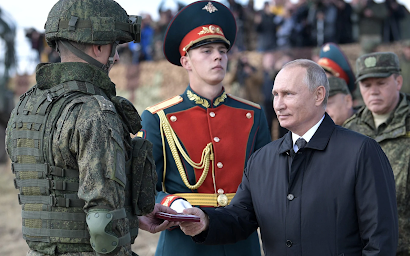
Are Putin's Days Numbered?


 Are Putin's Days Numbered?

Russia has been at limited war with Ukraine for over 4 years. There is no end in sight. Why? The answer to that question sits squarely on the President of Russia's shoulders. 

In 2015, separatist forces, backed by Russian direct military support, encircled what was left of Ukraine's best military units in the Battle of Debatsevo, Donbass. At that exact moment in time Russia had a choice to make: chase the battered remnants of the Ukrainian Army out of the rest of Donestk and Lugansk Oblasts; or cease the pursuit and make peace. Despite warnings from "The Rifleman", the famous commander of separatist forces in the Donetsk Oblast { allegedly also a senior Russian intelligence officer}, that failing to pursue the Ukrainians would lead to the Russians facing a far more built up Ukrainian Army in a near certain future conflict, Putin chose to withdraw support for any further advance. He famously harkened on the shared brotherhood of the Ukrainian and Russian peoples, and advocated that peace could be found in constitutional amendments that granted the peoples of Donetsk and Lugansk Oblasts rights to autonomy within Ukraine. This was Putin's first and most egregious mistake of this war.

His second mistake was to agree to the first Minsk Accord, and then the Second a year later. Both were obviously designed to give Ukraine time to rebuild its military, and fortify regions of the Donbass it still controlled. This was later admitted to by former German Angela Merkel, but it was obvious to any person schooled in the art of diplomacy and war. Putin would obviously fit that title.

The obvious became the evident when in February, 2022 Russia was forced to commit to a "Special Military Operation" to defend the newly created "Republics" of Donetsk and Lugansk. The Ukrainian Army had deployed its newly created, NATO funded and trained, army to the borders of Donetsk and Lugansk, and from all appearances the Ukrainians were ready to take back the territories. Putin chose to boldly confront NATO over this, and chose to lay the real gauntlet down. Russia, he said, was no longer prepared to be pushed around by NATO, and its never ending eastern expansion toward Russia's borders. He demanded a new treaty that rolled back NATO's presence and influence along Russia's borders, or he would defend them by force. It appeared at the time that Putin was reasserting Russia's deterrence. A bold move, and a necessary one given the disrespecting of Russia's core national interests by NATO.

The problem with Putin's stand was that he was apparently bluffing. After NATO refused to respect, or even acknowledge Russia's strategic concerns, Putin ordered the Russian military to invade Ukraine. This is mistake number three. Putin ordered the Russian Army into combat at the end of February. A time when the ground was still hard enough to support tanks and mechanized vehicles. However, as every Russian knows, its isn't long after that when those same fields turn to mud and stop armored movement. Parts of the Russian Army became bogged down in mud, while tanks that took to the roads were ambushed by US supplied shoulder fired antitank missiles. The portion of the Russian army that entered from Belarus made better progress and soon occupied neighboring communities of Kiev. The situation looked desperate for Ukraine, and its bargaining position was at an all time low. 

Then Putin makes his 4th bad decision. He again reverts back to the "brotherly peoples" story and in Ankara, Turkey he comes to an agreement with Ukrainian President Zelensky to end the Special Military Operation. Taking a quick and relatively easy way out of the invasion appealed to Putin's "low cost" strategy of war and diplomacy. Without anything being required of the Ukrainians to prove good faith, he volunteered a Russian Army withdrawal from Kiev and the territory to its north. No sooner had the Russians completed this show of good faith, the Ukrainians denied there was ever a deal and continued the war. 

The proof is clear. Putin's conduct of diplomacy and warfare was a near complete failure by 2022. However, in many ways, his failures since then have been even worse. Putin, it appeared, was all bluff. The US and NATO began calling Russia a "paper tiger". A toothless old beast. A relic of history. They called the Russian Army weak given the months and sometimes years it took them to take a single city- let alone having to withdraw from Kherson because they could not keep it supplied. In the beginning of the war US President Biden claimed he could not supply Ukraine with fighter jets, because he didn't want to start World War 3. Two years later all of NATO was supplying Ukraine with fighter jets. What did Putin do? Nothing. He huffed and he puffed, but did nothing. Ditto for tanks and artillery. Ditto for long range and cruise missiles. Nothing.

Sweden and Finland became so emboldened by Russia's nonresponse that hey joined NATO without fear for the consequences. The EU and NATO publicly acknowledged the funding of Ukraine's war that was and is killing thousands of Russians. What did Putin do? Nothing. He threatened, but each time that threat was empty. It was never carried out. Russia's power as a deterrent to stabilize competing forces in the world was crushed. US President Trump decided it was a good time for him to feed on the bones of Russia's sphere of influence. Moldova was overtaken by the EU. Georgia nearly repeated that fate. Armenia decided to ally itself separately from Russia, and closer to NATO. The Syrian government was overthrown. The Venezuela government was decapitated. Iran was attacked by the US, which remains the case today. The Cuban government has been threatened with invasion. It all comes back to the doorsteps of one man - Putin.

His poor judgement and appreciation of the situation has cost Russia dearly. The war that he constantly tried to avoid by appeasement has resulted in a long proxy war that has cost untold amount of Russian lives, and resources. It has cornered both Russia and China, and undermined the economic community of BRICS. In short, it has diminished the reputation that Russia not too long ago enjoyed of being the great nation that defeated Nazi Germany. Even today, simple steps could be taken to end the war in Ukraine quickly in Russia's favor. For example: Only a handful of bridges span the Dnieper River that connects Eastern and Western Ukraine. Destroying these bridges would halt almost all supply of weapons and resources from NATO to Ukrainian Army formations fighting in Eastern Ukraine. This could have happened at any time in the last 4 years. It would have saved hundreds of thousands, perhaps millions of lives. Many of those Russian. Putin failed to order this. In effect, he has prolonged the war and emboldened Russia's enemies by his failure to do what is obvious and necessary.

I once admired Russian President as a statesman. His ability to stabilize and grow Russia was impressive. However, it appears he forgot his own history. Afterall, it was the failure to put down the Chechen revolt that helped bring him into power as the strong man Russians love, and it was his ruthless pursuit of the second Chechen War that cemented him in the hearts of Russians. He now appears to be like the ineffective leader who oversaw the Chechens defeat the Russian Army, and no longer the strong man who acted to succeed. Is it any wonder why Putin's days could be numbered?




Tuesday, August 29, 2023

Operation Guillotine - The Coming Russian Counterattack


Lessons of war: every war is different, yet the basics remain the same - isolate and destroy. There is a hard way and their is an easier way to defeat your opponent. There is the art of war, and their is the wall of reality. The Ukrainians have shown more creativity and initiative in the art of war - likely through the eyes of their backers. The Russians started the war with a lot of imagination and initiative, but hit the wall of reality that splitting your forces is the best way to have them devoured - the wall of reality. They were forced to recoil, and the Ukrainians simply followed their retreat out of Kherson, Sumy, Kiev, and Kharkov Oblasts. The Ukrainian advance stooped just west of the Oskil River when Russian contraction allowed them to solidify defensive lines. The Ukrainians then made several ill-advised offensives for the flanks of the destroyed city of Bakhmut, which unnecessarily ate man power, resources, and time. They are currently attempting to capture Tokmak as a gateway to the Azoz Sea coast - which is mired in failure. The time may be ripe for a massive Russian offensive to decisively end the war. 

LESSIONS OF WAR

One of the biggest lessons of this war has been flanking major concentrations of enemy troops without sufficient distance between the parties is a recipe for loss. Loss can be in momentum, in troops, in equipment, in morale and in time - all enemies of a successful military campaign. We have witnessed this from both sides in this war. Whether its the endless Russian quagmires of Avdiivka and Marinka, or the Ukrainian quagmires of Bakhmut and Zaporizhia. Limiting    yourself to a flanking that exposes your forces to the maximum range effect of the enemies        artillery support, and mining, guarantees that your efforts will result in stalemate at best. This    has become the reoccurring theme of the Ukrainian War. So lesson one is flanking pincers must bypass major troop concentrations - not engage them. That's Blitzkrieg 101. The strategic aim to cut off supply to the enemy BEFORE engaging them in an attrition battle.

Lesson number two: piecemealing forces is a recipe for disaster. We witnessed the Russians commit this terrible strategy when they invaded Ukraine. It ended up in a loss of: momentum; troops; equipment, morale and time. The Ukrainians were able to survive and rebuild. What has happened since is piecemeal attacks by both sides, with the exceptions of Bakhmut and Mariupol, which have resulted in mass casualties with no significant progress - near stalemate in other words. Wars are not won on offensives conducted by battalion or less groups, yet that is what has been happening along almost all parts of the front by both sides - resulting in nothing but casualties and losses in equipment. 

Lesson three: concentrated, long range attacks against strategically imperative targets are highly effective. The Ukrainians essentially made the Russian positions in Kherson Oblast untenable when they rendered the Kherson bridge unusable. The Russians have been terrible at this - for  some reason. For example there are only two Ukrainian rail bridges crossing the Dnieper River: the Amursky Bridge in Dnipro; and the Petrivskiy Bridge in Kiev. Both those bridges still stand and allow Ukraine to transfer Western arms and ammunition to its forces in the most efficient  way possible, rail, given the size of the country. The hydro dam bridges that dot the Dnieper remain untouched - ditto for the car bridges. This one lesson appears to be completely lost on the Russian leadership, and has been a major strategic mistake harming Russian forces on a daily basis.

Lesson four: minefields stop troops and equipment from moving - Zaporiozhia for example. They can be used in an offensive or defensive posture. They can stop troops from advancing, and they can stop troops from retreating. Essentially, Russian mobile mine-laying units, like the modern ISDM Zemledelive, can be paired with armored formations to fix enemy flanking forces in place while bypassing them to greater depths. In a Blitzkrieg-like offensive, the ability to instantly trap the enemy in strongholds while on the move opens the doors to large advances. It is a combined-arms operation that hasn't been utilized well by the Russians. 

Frankly, the lessons of this war could be covered in a very thick book, and a simple blog can hardly cover it all. The bottom-line is the Russians are about to initiate a very large offensive of their own, and the only question is where and how. 

OPERATION GUILLOTINE

PHASE ONE

Given the lesson the Ukrainians taught the Russians in Kherson, which the Russians should have foreseen, any coming offensive must first sever the artery of supply. Without food, ammunition, and fuel a modern army cannot survive for more than weeks, so cutting supply is the first priority. To that end the Russians must first conduct a massive airstrike on Ukraine's most capable air defences - the German and American AD. Simultaneously, the Russians must destroy the railway bridges over the Dnieper so that Ukraine can no longer supply its forces with mass railway movements - that's two bridges. With major air defences destroyed, Russian strategic bombers focus on destroying Ukrainian artillery regiments in the Sumy/Kharhov regions. 

PHASE TWO

Russian airborne forces conduct mass drops along the river just west of Poltava. Their objective is to secure the river crossing (no bridges needed) for the coming armored and mechanized infantry forces that will surround Poltava and move on to Kremenchuk  and Dnipro. The Russian Army will use two centres for the start of their operation: Kursk and Belgorod. The Kursk group will flank the city of Sumy at a distance, isolating it as it goes with mobile mining, and proceed to the crossing points the airborne have secured. They will then isolate Poltava in the same fashion as Sumy, and proceed to the Dnieper. The second grouping, from Belgorod, will also flank Kharkov at distance, isolating it in the same fashion with mobile mining, then move to the eastern part of Poltava, isolating it, and meeting up with the Kursk grouping at Dnipro. It is critical that the route of the advance is not too narrow, avoids rivers requiring bridges, and is open enough for armored/mechanized warfare. No forests, no rivers, no cities and as few tree lines as possible.

PHASE THREE

Having secured its positions in Phase Two, the Ukrainian forces in Eastern Ukraine will be trapped and without supply. The Ukrainian forces in these areas will have no choice but to surrender. They won't do so immediately, but the plight of the troops and the fury in Kiev will likely force the Ukrainian military/government's hand. A show of successful force in a decisive manner, will likely quiet the war drums beating in places like Poland, etc. However, even if this offensive succeeds, and it does not quiet the warmongers, it will leave Russia in the position of controlling all of Eastern Ukraine, and opens the doorway to Odessa. Time will tell what path the Russian military/government choose, but whatever they choose must incorporate the lessons of this war, otherwise the fingers must be pointed inward.   


Monday, March 27, 2023

Ukrainian and Russian Offensive Options

 It's been just over a year since Russia launched its "Special Military Operation" against Ukraine, and what a year it has been. Many mistakes have been made by both sides, and if NATO had not intervened to supply Ukraine with weapons, and just as importantly money, this war would have been over in three months at the most. In particular, shoulder fired anti tank weapons paralyzed the Russian advance, which due to the time of year, was reduced to funneling along road ways which became killing zones. The Russians, having lost the initiative of a quick lightening attack, became overstretched and in a vulnerable position. The Ukrainians took advantage of that by launching their offensive in Lugansk, Kharkov and Kherson oblasts. The Russians then had no choice but to with drawl to a defensive posture that its army could defend. That sums up the first year of the war more or less. 

The big question is what are the next battlefield moves. Ukraine is facing some difficult choices in this regard. Although much has been made by Ukrainian and Western propaganda of the successful Ukrainian "counter offensive" (which is the political term for counter-attack") in driving Russian troops back, this is a bit of a stretch. The truth is when Russia failed to capture Mykolaiv, and thereby open the door to Odessa, the only real defensive position they could take was the city of Kherson and the Dnieper River. American exports of Hymars rocket systems to Ukraine, which constantly damaged Russian crossings of the Dnieper, forced Russia to abandon the city of Kherson and establish defensive lines on the opposite side of the Dnieper. Up until that time, Ukrainian troops were suffering defeat after defeat in the fields north of Kherson, so it wasn't Ukrainian offensive tactics that one the day, but rather strategic tactics.

In Kharkov/ Lugansk oblasts it was a similar story. It was not so much a feat of arms that dislodged the Russians from this area - it was overrun because Russian forces were very over stretched and had to withdraw to defensible lines. That brings us to today. The Russian Army is no longer in a position of being overstretched. It has had time to reinforce defensive lines along the front, and increase the size of its forces engaged in the conflict by 300,000 troops (not including Wagner units). Importantly, the Russians have hurriedly upgraded their acquisition and use of drones. This leaves Ukraine with the stark choice of where to conduct an offensive (the much touted "spring counter offensive") as demanded by their Western allies. 

The most talked about, and perhaps obvious choice is an attack along the southern front from Zaporizhzhia, which would aim to capture Melitopol and Mariupol - effectively ending the Russian land route to Crimea. However, that option is also obvious to the Russians, and the area has been heavily fortified and reinforced. The Russians also have the advantage of almost immediate air and naval support from Crimea and area and Rostov-On-Don. While the Ukrainians may try this in an act to appease their backers, should they use massive resources to do so, and lose, their war could be over. Therefore, from a Ukrainian perspective, a large southern assault should be out of the question. Ditto for attacking Crimea in force. That leaves the Donetsk city front, the Bakmut front, or the Russian front as options. 

Both Donetsk and Bakmut fronts are fortified areas that would chew up Ukrainian troops. While a significant attack in Bakhmut, when the ground is dry, may cause the Russians to withdraw, the Ukrainians would be faced with the Severodonetsk area. Built up area after built up area, mostly in ruins. As World War Two showed, cities full of rubble make the job of defence much more easy for the defenders. That leaves the last option - the Russian front.

In the last year Ukraine has shown two traits: embarrass Russia; and try to provoke a greater war in the region. The ideal way to do that would be an invasion of Russia itself - namely Belgorod. Belgorod is a Russian city very close to the Ukrainian border. Not far away from Belgorod is Kharkov, which remains firmly in Ukrainian hands. The Ukrainians can use Kharkov as a strategic supply point for their troops entering Russia and a battle for Belgorod. Undoubtably the Russian military would see such a buildup in Kharkov with their satellites, but what if they decide it also serves their strategic purposes that Ukraine makes such a move. Given that all the other fronts will cost Ukraine massive casualties and loses of equipment, it makes sense to kill a few birds with one stone. No doubt their allies would say "you can't expect Ukraine to fight on its own soil only when it was invaded by a hostile act..." 

On the other side of the fence, Russian military planners have to decide what their next move is. While the intel on Russian forces dispositions is limited to us, we know they called up 300,000 reservists. About 80,000 of those were current enough in their training to join the conflict immediately. Where the other 200,000 plus are is a bit of a mystery. Many channels are suggesting these troops have been going through thorough training with combat veterans. If that is the case, and they have not yet been committed to the fight, Russia has a powerful force for its own spring offensive. However, I doubt this will be the case. 

Russia, unlike Ukraine, has no pressure from its allies to conduct an offensive en masse. It seems quite content to engage, pin and destroy Ukrainian units - namely in Bakhmut and Avdiivka. It uses mainly conscripts in Bakhmut, and thereby destroys Ukrainian units while leaving its regular army in one piece. This is how the Russians do military strategy and they have in every major war they've been involved in. Fewer people at home complain about losses when they are people who were in prison. The same mentality exists in the West, but is rarely acted on as it is in this case. Russia has also learned, you would think, that big offenses that stretch your troops too thin bring drastic consequences. 

To avoid these consequences I believe Russia will stand pat until after the Ukrainians commit their troops in an offensive. Once the Russians have defeated the Ukrainian offensive they will go on the counter-attack. That is likely the time that the 200,000 troops in training will be committed, but to where?

Given that the Russian Army is currently trying to take Bakhmut many speculate that Kramatorsk and Slavyansk will be next. However, both cities are heavily fortified and would prove to be worse than Bakhmut in terms of manpower/equipment necessary, time and casualties. It makes more sense that the Russians would head south from Bakhmut, through Kostyantynivka and onto Pokrovsk. Pokrovsk is a hub city like Bakhmut, and capturing it would cut off Ukrainian troops entrenched around the city of Donetsk. The Russians are currently fighting in, and have captured most of Marinka. Once Marinka is captured the Russians could move along the road to Kurakove. Once Kurakove is captured the Ukrainian Army in Donetsk city area will be fully surrounded in what the Russians like to call a "boiler". Cut off from resupply, and unable to retreat, the enveloped Ukrainians will have no choice but to surrender. This seems like a logical path for a Russian offensive. 


Whatever the case may be in the coming months, look for the Ukrainian Army to make the first move, and Russia to take the advantage in response. 

Monday, November 21, 2022

Russia's EMP hits Ukraine


Nine months into the war between Russia and Ukraine, and to say it has been topsy turvy would be an understatement. Russia began the attack on Ukraine with a five-pronged assault, which was clearly aimed at forcing the Ukrainian government into a quick capitulation on Russian terms. However, Russia picked the wrong time of the year to go on the offensive which, when combined with western anti-armor missiles and satellite intelligence proved to be the impediments to Russia's victory.

Russia's war on Ukraine has been akin to "what not to do" when invading a foreign country. A very crucial mistake by the Russian military was forgoing an air campaign against Ukraine's air force, air defence units and critical infrastructure like the bridges over the Dnieper River. The winter weather in February meant   Russian armor and mechanized infantry, along with truck-borne supply lines, were road-bound and sitting ducks for Ukraine's newly acquired shoulder-fired anti-armor missiles.  

Things quickly bogged down, and in short order Russia was having to conduct fighting withdrawals around Kiev, Sumy, Kharkov and areas. The undermanned gamble turned into the undermanned being exposed. New lines of defence were shortened to give out numbered Russian troops a fighting chance at holding what they had left. Unfortunately, even that was too much ground for them to defend, and subsequent withdrawals were needed in Kherson and Kharkiv. Essentially, this was a military disaster born of political strategy rather than sound military strategy. It has all the hall marks of Russian President Putin's thinking at the time - treat Ukraine nicely as they are brother Slavs and brotherly nations. So much for brotherly love. 

That brings us too today. Having crossed the Dnieper River, and feeling safe there, Russians have dug in to defend their land bridge to Crimea. On the Donetsk/Lugansk fronts the Russians and Ukrainians are trading moistly fruitless attacks all along the front. Ukraine appears to be transferring freed up units from the Kherson front to the Zaporozhye front. It appears they are preparing an assault aimed at taking back Melitopol and Mariupol, thus severing Russia's land bridge to Crimea, and gaining their access back to the Azoz Sea. It is a tall order, especially as winter begins to set in, but being audacious hasn't tied the hands of Ukrainian commanders so far. 

The Russians, for their part, seem to be considering doing what they ought to have done in the first place - an air campaign. The "Coalition of the Willing" bombed Iraq for 30 days before sending a single unit into the fray. Now Russia is doing the same in retrospect - having already suffered the losses which an air campaign is meant to avoid. The interesting part of Russia's strategy has been targeting Ukraine's electrical system. As of this date, the Ukrainian government claims 50% of its electrical systems have been destroyed. Replacement parts to rebuild these systems can take up to ten months to manufacture. It's a recipe for disaster for Ukraine.

Every person that lives in a country with harsh winter understands that without energy you cannot sustain life. It doesn't end there. Ukraine can evacuate its population to Europe, but what it can't do is save its infrastructure. Namely, without heat all the plumbing, water and sewer, will freeze solid over the winter. Homes will be ruined, businesses will be destroyed, water and sewer plants will be left useless, and Ukraine will become a ghost land. What the Russian missile campaign has managed to do is roughly the equivalent of an EMP strike without the nuclear detonation. If Russia continues its campaign to completely destroy Ukraine's power system, and in the process destroys the infrastructure necessary for modern life, then the result is the country of Ukraine is a vast, vacant land with no ability to reconstitute itself without Russia.

Furthermore, the tens of millions of Ukrainians that will have no choice but to evacuate Ukraine will flood Europe, which is already desperately rationing power for its own citizens, resulting in an economic shock to Europe and possibly the world. The effect on the battlefield will be just as devastating. Troops will lack the basics to heat and feed themselves. Supply lines for just the basics will stretch across Ukraine and into Europe - a recipe for disaster. Many people in the general public do not understand just how close to the abyss Ukraine is right now. Not unlike Russia in the early days of the conflict, people see Ukraine as walking over the Russians. However, not unlike Russia in the early days of the war, Ukraine is becoming overstretched given the collapse of its infrastructure and the march of "General Winter".

A number of sources have been suggesting that Russia has given Ukraine an ultimatum: Get to the negotiation table by the end of November or have the last of your electrical infrastructure destroyed. Effectively, get to the negotiation table or have your country sent back to stone ages. A daunting choice indeed. Ukraine has apparently responded to this strategy with a kamikaze-like strategy of its own - missile strikes on the Russian controlled nuclear plant at Zaporozhye which, if the plant is damaged, would have the effect of a nuclear strike with deadly radiation spreading over the region - including Russia. When it gets down to it, both countries are upping the ante to a nuclear war without the nukes. This is where it's at with nine days left in November as Ukraine begins to slowly freeze over.


Saturday, September 10, 2022

Russia's failings in Ukraine


 The Russian invasion of Ukraine has three primary goals: geo-strategic; strategic; and tactical. The geo-strategic goal is decouple Russia from the Western economy and integrate heavily with China and other Eurasia leaning nations. The invasion of Ukraine resulted in massive sanctions as promised by Western powers, and as a result Russian President Putin was able to get his population on board with decoupling. Putin's moves to bolster the Ruble by requiring for purchases of oil and gas is a good example of this. On the geo-strategic front it is clear that Russia has won the war.

The picture is a lot less clear on the strategic/tactical front. On the strategic front, Russia's primary goals are clearly to make Crimea sustainable as an unsinkable air craft carrier that dominates the Black Sea. To achieve that goal Russia must, at a minimum, secure Kherson and Zaporizhzia  oblasts (provinces). Unfortunately for Russia, the war in Ukraine has shown that Crimea is very vulnerable if Odessa oblast is not secure. The strikes on Russia's Black Sea Fleet, and air bases located on Crimea make it crystal clear that securing Crimea means securing Odessa oblast. To this end Russia has not put as much as a dent on Odessa, and it must be said that strategically they are failing here. 

The other areas of strategic necessity are the Donetsk and Lugansk Republics, which are collectively known as the Donbass (region). The Donbass gives Russia strategic depth on its southern flank which is critical to protecting its underbelly. Donetsk Republic contains massive gas and oil fields (mostly untapped as yet) which a Eurasian Russia would want in its back pocket rather than the West's. For all the above reasons, the oblasts that are strategically necessary for Russia are: Crimea; Kherson; Zaporizhzia; Donetsk; and Lugansk. Another city that is very important for Russia to capture is Kharkov/Kharkiv.  Kharkov is Ukraine's largest city and it is located right on the Russian border. As such, Kharkov offers a main supply and logistic hub to any forces (Western included) to invade Russian territory. With the notable exception of Kharkov and Odessa oblasts, Russia has secured, or is securing the remainder of the oblasts. It has therefore been roughly 70% successful strategically. 

The tactical picture, however, has been a nightmare for Russia. Starting with the Russian air force. Recall US heavy bombers carpet bombing the Taliban which paved the way for the Northern Alliance to advance and defeat the Taliban (short term). So, where are the Russian heavy bombers and the carpet bombing of Ukrainian formations? Russia has 125 strategic bombers, but is not carpet bombing Ukrainian forces. That is the number one tactical failure. Why is the Ukrainian air force able to still fly planes and helicopters over Ukrainian air space? Russia has 1533 fighter jets, but is unable to establish air superiority over Ukraine. That is the second tactical failure. Why has Ukraine been able to strike Russian air fields, bases, ammo depots, ships, and important bridges with their missile systems? Russian air defence has at least 410 launchers of the S-400 variety. That doesn't include the S-300, Pantsir, or other systems. It seems here that Russia is reluctant to use the S-400 system in an effort to keep that system cloaked from NATO. However, the failure of Russian air defence systems has been a very serious third tactical failure for Russia.

The failure of the Russian Navy to make much if any impact on the war is notable. The Black Sea Fleet has not been decisive in any way during the conflict, despite the fact Ukraine no longer has a navy. Not to mention the Moskva, the flag ship of the Black Sea fleet, that was destroyed by the failure of the aforementioned Russian air defences in Crimea. A fourth tactical failure for Russia. The list goes on. 

In some ways it is amazing that Russia has been able to make the progress it has. That progress is largely attributable to the arm of the Russian Army that has not failed - the artillery and missile forces. Russian fire power has dominated the battle space. Other units that have distinguished themselves are: airborne forces; Chechen forces; and Spetsnaz forces to name a few.

In a sense, Russia has been the author of its own tactical failures in Ukraine. It's the old "half-pregnant" strategy that dooms every military in history that has tried it. Unfortunately, it looks like political objectives are knee capping military operations. Russia entered this war because, as US President Biden said, "it has no choice". Ukraine was preparing to invade and put down the self-declared independent republics of Donetsk and Lugansk. Either Russia acted or it watched Ukraine take strategic territory back. It's the "how" it reacted militarily that has caused all the issues for the Russian military since. Rather than using an air war, for at least a month as the US did in Iraq, the Russian military attacked with almost no air war first. That can be considered akin to charging trenches without artillery first...

The initial goal was to topple the Ukrainian government in a lightening strike on Kiev. That is what the columns form Belarus and Belgorod areas were meant to do. The massive forces tied up in this operation, political gamble if you like, could and should have been deployed in the south of Ukraine to undermine the rear of the Ukrainian defences in the Donetsk and Lugansk republics. This is only common sense militarily. The soft under belly of Ukraine if you will. All bridges on the Dnieper River should have been destroyed by air and missile forces, in the first hours of the war, to cut Ukraine in half and deny reinforcement and resupply to Ukrainian units trapped in the east. These are military goals and are not based on wishy washy political gambles. 

Whether Putin took advice from others or not, the responsibility for the tactical failures of his military rest on his shoulders. Even to this day all the bridges across the Dnieper River remain intact. NATO is able to funnel heavy weapons and ammo to Ukrainian troops in the east almost unfettered. Without specific intelligence it is hard to determine whether or not the Russian Army argued for a more focused, less political armed intervention in Ukraine. It does, however, have the feel of a political gamble gone bad. It does have the feel of a cat and mouse game, similar to the approach of intelligence forces that Putin once belonged to, than steel fist of a military campaign. In a war of annihilation, which this is becoming, political considerations get thrown to the way side - especially when your geo-strategic goals have already been met. To do less is to show your sworn enemy that you are weak, as evidenced by the massive escalation in Western military support for Ukraine. Weakness, or the perception of it, may lead to all the wolves closing in for the kill.


Friday, April 29, 2022

Ukraine - Master of its own Demise

 Two months into the invasion of Ukraine a few things have become obvious. The first and foremost thing to surface in the Ukraine conflict is the absolutely shameless abuse of propaganda by the Ukrainian government. Whether it was the defiant slaughter of thirteen Ukrainian Marines on Snake Island, which ended up being the surrender of almost 100 Ukrainian paratroopers and no slaughter, in reality, or the shelling of a train station in Donetsk by a Tocha missile, which Ukraine blamed on Russia, but which was subsequently discovered to have a Ukrainian serial number, the Ukrainian government has been shameless and irresponsible in its rhetoric. Before the war started it similarly provoked the super power on its border - as if it has a death wish. When Ukraine points the finger at those responsible for the war, or at those it accuses of not doing enough for it, there are a thousand fingers pointing back at it.

Let's face the obvious: Ukraine has been used by our western governments as a tool to, as they now admit, to weaken Russia. This has been on going for over a decade. It is a matter of fact that the West was involved in the overthrow of Ukraine's President in 2014. A president who was duly elected - primarily from the Russian speaking portions of Ukraine in the east and south of the country. It's a matter of record that the overthrow was caused by the Ukrainian President's refusal to follow a path to join the EU. It is a historical truth the the Ukrainian military shelled, bombed, and otherwise attacked separatists when they declared independence from Ukraine as a result of the overthrow of their president - this despite the UN's declaration of the principle to self-determination for people and regions around the world that seek it. The West refused to criticize Ukraine's military assault on its own citizens, and immediately recognized the new head of Ukraine. 

The Ukrainian government signed two accords (Minsk) in an effort to end the civil war in the Donbass. However, it failed to live up to the requirements of the agreements by refusing to grant the Donbass special status as it had agreed to do. It did not live up to the requirements that foreign troops would not be present in the Donbass or Ukraine. The list goes on. In reality, the Ukrainian government said whatever it needed to say to get itself off the hook at the moment, and this unfortunately has become a trait that has damned the country of Ukraine, and threatens to set off a major world conflict.

In the days leading up to the Russian "special military operation" (in reality an invasion with specific political and territorial goals), Ukraine and the West which backed and trained its military, had a chance to seriously address the concerns of Russia, but instead they brushed Russia off as if it were a third-rate power living in the past. This approach, this view, has been catastrophic for Ukraine and may become catastrophic for the world. It was four years ago, in October of 2018, when Russian President Putin warned the world "Russians will go to heaven as martyrs ... The aggressor (the West) will have to understand that retaliation is inevitable, that it will be destroyed and that we, as victims of aggression, as martyrs, will go to heaven. They will simply die because they won't even have time to repent." Source here He was referring to the then new hypersonic weapons they had developed, and which today have become a reality on the Ukrainian battle field.

Despite all of these terrible consequences, Ukraine, and our western governments, have simply sought to further antagonize, and by doing so increased the severity of the conflict. Ukrainian President Zelensky, in particularly, has acted so recklessly with his country's existence that it begs the question: does he want to seek Ukraine as a country taken off the map? In the days before the invasion he refused to agree to live up to Ukraine's signature on the Minsk Agreement. His Western partners, namely France, Germany and the UK, who were all guarantors of the agreement along with Russia, did absolutely nothing to force Ukraine and Zelensky to live up to their agreement. Zelensky not only refused to implement the Minsk Agreement, but went further stating Ukraine was going to join NATO. These are not actions of a person or government seeking to avoid conflict and tragedy for their country and people. These are actions of a minor power recklessly punching over its weight, undoubtably reassured by other governments of support should Russia act.

It is of course noble to state that a sovereign country can do as it wishes, but everyone understands the reality is different. For example, if Canada were to enter a military alliance with China, and have Chinese military personnel training and arming the Canadian army, does anyone seriously believe the US would simply stand by and say if Canada wants to be in alliance that is their sovereign right and we support it? No, that would never happen. Simply look at the diplomatic roar over tiny Solomon Islands entering a security pact with China as an example. Funny enough, the US intervened in the Freedom Convoy protests in Canada simply because their car manufacturers could not receive parts and had to close a few plants temporarily. The position that Ukraine, or any other country, can do whatever it likes as a sovereign nation has never been true throughout history, and it makes a mockery of the intelligence of those who suggest it can. 

Nevertheless, Zelensky lectured the world that Ukraine was the victim of an unprovoked attack. Not just that, but it was a victim of  NATO lacking courage, the EU lacking courage, and pretty much everyone who disagreed with its position was a Russian sympathizer. There was no room for intelligent, level headed people to have a different opinion. Much like Prime Minister Trudeau's public statements that people protesting for freedom in Canada held "unacceptable views". 

The problem with Zelensky, and the Ukrainian government in general, is that it has become like the "boy who called wolf". It has made so many false claims that one simply can not believe what it says anymore. Take for example its constant claims that Russia has suffered massive casualties thus far. Perhaps it has, but Ukraine has never released any of its own casualty numbers. It claims to have defeated Russia and destroyed much of Russia's equipment, yet it is the one screaming for tanks, artillery and anti-aircraft systems. Ukraine had plenty of these arms before the war, so the natural conclusion is Russia has destroyed much of it and they need theirs replaced. Ukraine has condemned Russia in every other day UN Security Council meetings for attacking civilians and civilian buildings, yet it armed its own civilians and its troops took up positions in civilian buildings as matter of course. 

All of this leads to one unmistakable conclusion - the Ukrainian government cannot be trusted. Not that Russia is an angel. Nor is the US or any other Western power, and if you believe they are you are very naive. They all have "interest" that reign well above their principles. Ukraine is no different in that regard. It is not the innocent victim it portrays itself. Its government has been willing to sacrifice its own people unnecessarily. That shouldn't be surprise to anyone that has followed the conflict since 2014. A government that is willing to fire artillery and bomb its own citizens for wanting a different future is not a government that minds wasting the lives and dreams of its population.     


Friday, April 1, 2022

Why Russia is winning the War in Ukraine


In order to know whether or not Russia is winning its war in Ukraine one has to figure out what the goal of the war is. Afterall, regardless of casualties and loss of equipment and resources, the primary objective of any conflict is its original mission. The best way to think of Russian strategy in Ukraine is to view it as one of those famous Russian egg dolls that have successively smaller dolls within it. 

Russia's stated goal in Ukraine is to de-nazify, de-militarize, and annex territory from Ukraine. The word annex in this case means the formal recognition by Ukraine of Russia's annexation of Crimea, and the recognition of the Donbass as an independent republic - which would presumably vote to join Russia. Those are the stated goals. The next obvious goal, which is not stated, is the annexation of the Kherson region to protect Crimea's water supply and form a land bridge to Crimea. The next much less obvious goal would be the Russian occupation and annexation of all Eastern Ukraine - including Odessa. This would make what's left of Ukraine an impoverished, landlocked no-mans land between Europe and Russia. All of these stated and non-stated goals are either obvious or can be logically deducted from Russia's military movements.

The smallest, and least visible goal,  the smallest of the dolls, is the most important of them all - kicking off the "newest world order". To understand this one must focus on the thought and strategy of Vladimir Putin. Putin is a judo master, and as such the philosophy of Judo rules his strategic thought. The primary principle of Judo is to use the opponents own force or weight to defeat him. Putin's use of this strategy is evident on the domestic and international stages. In this case, Putin has used NATO's (US) strategy to contain Russia (and China), with its push to Russia's borders, as momentum to "Judo throw it" if you will. The encroachment on Russia's traditional buffer zones, being those states on Russia's borders, has given Putin the reasoning needed to convince the Russian people that he must act. Remember the "we have no where to retreat" speech. 

At this point, Putin has grabbed the proverbial collar of the West - being the starting of the Ukrainian war. The US and Europe continued to push Putin with large weapon shipments to Ukraine, and massive sanction packages aimed at destroying the Russian economy. The force of these sanctions was meant to throw Russia to the ground, but instead Putin used that very force against his opponent. He began with steps to stop bank runs in Russia, shut down the Russian stock exchange to avoid a similar run, and essentially planted his feat firmly on the ground. Then, with European countries threatening to ban all Russian exports, including oil and natural gas, Putin completed his throw and threw the US and Europe to the proverbial ground - rubble only payment for natural gas and all other exports from Russia. That was the point of the war in Ukraine - the death of the US hegemony and by necessity the US dollar. 

Previous to the war in Ukraine Russia had made agreements with the Chinese to use yuan and rubbles for internal trade. Since the war, Russia has been making agreements with India, Pakistan, Iran and others to conduct trade in national currencies - not the US dollar. From hereon in the largest markets in the world, China and India, will not need US dollars for trade in natural resources, and that means the US dollar has lost at least half its worth in real terms. Even Saudi Arabia, with a staggering 70% of its oil exported to Asia, is realizing that it must pick a side in this global divide. It has now begun negotiating with China to sell the oil in Yuan - not US dollars. This breaks an agreement it has has since the 1970s with the US to sell its oil in US dollars exclusively. The need for US dollars has propelled the dollar to the most sought after and valuable currency in the world, and that in turn has propelled the US economy. All that is about to change in a very radical way. 

The take away here is that, while on the face of it the war in Ukraine is being described and thought of as a proxy war between Russia and NATO, in reality it is meant to be the catalyst for a bi-polar world - one on the rise (Eurasia) and one on the decline (Atlantia). A massive shift propelled by the elites of the world - in all nations. A deliberate move to consolidate the world's many countries into two camps. One often hears the phrase "divide and conquer". You can properly think of this as the age of "consolidate and conquer". It's the phase before the move to one world government. As US President recently said: "There will be a New World Order, and America must lead it". This is what we are truly witnessing today. Not Russia bad Ukraine good. Not China and India must pick a side. Not any of the rhetoric designed to baffle and indoctrinate the ordinary person. So, if you consider that Putin, and by extension Russia, are playing their roles in the creation of this "New World Order", then you know that Russia is winning the war in Ukraine.


Wednesday, March 16, 2022

Russia's Battle Plan in Ukraine


Three weeks ago to the day Russia launched a multi-force, multi-direction, and multi-purpose invasion of Ukraine. The Russian government called it a "Special Military Operation", much like the Ukrainian government called their military crackdown on Donbass separatists an "Anti-Terrorist Operation". One can't help wonder if the Russians weren't having a bit of fun with that one. Bottom line is, as was predicted here, the Russians did invade Ukraine on multi-fronts to: isolate the Ukraine army positioned against Donbass separatist forces, encircle Kiev, and occupy the Russian "L" stretching from Cherniv to Odessa on the eastern bank of the Dnipro River. 

The question at the moment is this: what happened to the plan? Any person with any military experience knows the old saying: "a plan only survives until first contact with the enemy". That is clearly the Russian experience in Ukraine. The problems with the Ukrainian campaign began at the top. Russian President Putin was using his military as a tool of politics, and that was and remains his major mistake. Much like the US government's political objectives in the Vietnam war, which in many ways tied the hands of its forces and caused many unnecessary casualties, Putin started this war with clear political objectives in mind. It is clear that these political objectives included: non-use of serious weapons in civilian areas; non-use of strategic bombers for carpet bombing; non-use of naval borne cruise missiles of guns for shelling; the list goes on. Essentially, Putin was trying to present the Ukrainian government with a fait a compli so that sober minds would realize resistance was futile and they would capitulate.

That was the best case scenario. Instead of conducting an air campaign like the US did in Iraq (for a month and a half), the Russian military moved in after mere hours of missile and air strikes. The result was that Russia did not destroy Ukraine's air defences and air force completely before entering ground forces, and perhaps more importantly did not cripple Ukrainian's will to fight. There may have been  geo-political/strategic reasons for this, or there may have been political calculations, but the bottom line is that Russian planes and helicopters were vulnerable, and remain so. That means, necessarily, Russian ground troops suffered unnecessary casualties from Ukrainian artillery and tanks. So the Russian command gave up prudent military doctrine to satisfy the political goal of not alienating eastern Ukrainian civilians for a post conflict order. In other words, it got too cute.

The Russian Navy has also been conspicuous by its absence in the campaign. It has complete dominance in that area of the Black Sea, yet has only fired six cruise missiles at an air base. You can also throw in the Russian strategic resources like heavy bombers and massive electronic warfare assets which have basically remain unused. All these forces would have made a massive difference in the three weeks of battle thus far. While not using the navy or strategic bombers may be incorporated under the strategy of not alienating the population, or political reasons  in other words, the very limited use of electronic warfare is more likely strategic in nature. Russian strategic thought is to keep its capabilities close to its chest until the big war happens, ie: World War III (hopefully that never happens). A good example of this is the recent discovery that Russia has decoy missiles in its barrages of missiles that fool the enemy's anti-missile systems, which was unknown until then. 

The primary difference between an American war and a Russian war today seems to be the Russians are trying to placate a population before they occupy them, while the Americans level the place and face uprisings thereafter (ie: Iraq, Afghanistan; etc). That doesn't mean the Russians won't face the same in any case. Certainly the main stream media, and social media, have portrayed the Russians as leveling Ukraine. However, from a military perspective, this is far from the truth. From a strictly military perspective Russia would be guilty of not using all its strategic and heavy forces to ensure its troops didn't take unnecessary casualties, and objectives wouldn't be impeded. Certainly the US or NATO would never be accused of that.

The US has a strategy of  "battle space dominance". The idea is that its forces must dominate every aspect of the battle space on air, land and sea. That strategy has been woefully lacking in the Russian's Ukraine campaign. Ukrainian tanks, and especially artillery have been relatively unbothered moving around Ukraine. NATO has managed to transfer anti-tank, and anti-air man-held portable missile systems to Ukraine without any issue. The systems have found their way to the individual fronts. Here there are collective failures in intelligence, and forces designed to restrict battle space. That may have been the reason two senior Russian intelligence officials were detained by their government. It may also point to a lack of precision weapons and/or drones that can interdict these supplies en route, or it maybe a case of sacrificing soldiers and tanks on the ground to keep military capabilities hidden from NATO forces. Don't forget the Russians sacrifice in WWII, like one rifle for two men. That dedication to "Mother Russia" is still there. Whatever the case, Russian troops and Russian objectives are paying the price on the ground. Unfortunately for the Russian military, troops morale may well suffer when they realize weapons that could be employed to limit their chances of being killed are not being used.

The last week of the campaign has changed somewhat. It appears now that Putin's grand gesture to the Ukraine has been replaced with some military imperative. Strategic missiles were used to destroy a Ukrainian base on the Polish border housing foreign volunteers, and more than likely NATO arms. Russian ships fired off a few more cruise missiles near Odessa. The cities of Mariupol and Kharkiv/Kharkov have been facing methodical military bombardment. This is the way of war. Ask the people of Mosul, Bagdad, Tripoli, Benghazi, Aleppo, the list goes on and on. If your military chooses to put its positions in a city, don't be surprised when the city is levelled to defeat you. My own father fought in the city of Ortona, Italy in WWII, and the place was levelled. He was at Monte Casino too, which was a beautiful historical monument that German paratroopers decided to make a defensive position. The US air force bombed it into oblivion - no questions asked. This is the ugly truth of war, no matter how many "Karens" scream about it. The self-righteous, hypocritical posturing of the US and some other countries is frankly upchuck worthy - especially amongst military people who know the truth of war.  

 It is now the beginning of the third week of the war in Ukraine, and news is "leaking" out that Russia and Ukraine are close to signing a peace agreement which pretty much includes all the demands Putin put on Ukraine before the war started. That being said, it seems inconceivable that Russia would sacrifice so much for so little. Even if Ukraine agreed to formally cede the Donbass and Crimea to Russia, it still leaves Russia without a land bridge to Crimea, and Russia already effectively controlled both anyway. Therefore, given the Russians already fully occupy the Kherson region we may see a referendum there on Kherson as an independent republic or a part of a Donbass/Kherson republic, or a part of Russia. If Russia is preparing to sign a deal, then an attack on Odessa would be out, Odessa would remain as Ukraine's only sea port. It also seems counterintuitive that Russia would miss the chance to take all of eastern Ukraine, making the Dnipro River the new "Iron Curtain". Afterall, once you have gone all in you may look very weak to leave with nothing of much strategic or even tactical consequence. Such a face to your enemy will likely embolden them to come for your throat. That, after all, kind of defeats Russia's stated objective of deterring NATO aggression against it. 

Tuesday, March 1, 2022

The Ukraine War - It's not what you think

 The world is a stage and we are but mere actors. Never has this saying been more true than today.  We are witnessing the making of "heroes" and "villains" in Ukraine and Russia right now. The Ukrainian President has been pumped by western media as some kind of modern day Churchill as he, with no military experience, "personally directs the defence of Kiev" from within the city. A hero, and potentially a martyr all in one. We have the Ukrainian military being hailed for putting up a "heroic" defence against the Russians. And, of course, we have Russian President Putin painted variously as the bad guy, evil guy, insane guy, ... you get the idea. Good guys vs bad guys, black vs white, demonize vs canonize - such is the evil pit that the world has evolved into.

We see this very painting of people here in Canada as well. Far from the flames of the Ukrainian war. Truckers are heroes. Truckers are terrorists. One Liberal cabinet member just referred to truckers in the Freedom Convoy in Ottawa as, wait for it, "terrorists".  We have just come through two years of what can only be described as the worst violation of civil rights in Canadian history - mass vaccination requirements, lockdowns and mandates - all designed to get Canadians used to the suspension of their constitutional rights as some sort of natural right the federal government, and provincial governments can exercise at will. The Canadian government even invoked the Emergency Measures Act, renamed by Mulroney but then known as the War Measures Act, to suppress an act of defiance and civil disobedience via protests on Parliament Hill. Rights you thought were sacred two years ago evaporated in a woke moment. It has been the same throughout most of the world.

So how does Ukraine fit into this? Well, three words: World Economic Forum. The WEF is a multi-national private organization born in Germany, now with its headquarters in Davos, Switzerland. It's primary purpose, like other German fathers of the same vision (Marx and Engels most recently), is to turn the world into a one government utopia where humans have no rights to property, religion, beliefs other than the WEF's, etc. In the words of the nominal head of the organization, the "Fourth Industrial Revolution". If that sounds a lot like another German phrase, the Third Reich, you can be forgiven. Both have their origins in Germany, both seek world dominance, both sought to conquer/control Europe (ie EU), both sought to conquer Russia/Soviet Union after gaining control of Europe, both believe in genetic manipulation of the human species, you get the idea. They don't call themselves Nazis anymore. The new term they love to use is "Globalists". 

The Globalists aim to conquer states from within, that is to say they mentor and put in place leaders and politicians that they control. (don't believe me? watch the video here. Interestingly, Schwab even refers to Putin as one of his guys. This takes us to the "we are all actors" part. What is really happening in the Russo/Ukraine war, and more importantly, what is the purpose of it.

The primary point woman from Europe is Ursula Von Der Leyen, a German (again) physician and politician (first woman to serve as Minister of Defence in Germany). Some of her mentors shown below:


In case you aren't familiar, the top picture is her with Henry Kissinger, and the lower picture is her with Schwab. Her job in all of this is to direct European states, and people, to prepare them for war against Russia. As you may have noticed from the emergency session to grant Ukraine EU membership, the European Parliament was decked out like some kind of Ukrainian birthday party. The new Chancellor of  Germany is newly elected Olaf Scholz - pictured below (with Schwab):


For the WEF, and its backers, the most important aspect of their plans is what can loosely be called the "schedule". The schedule is used to determine the length of time politicians stay in office, the bringing up of "young politicians" as Schwab refers to them in the video link above, the stacking of governments to implement its policies, and finally the beginning of the "Fourth Industrial Revolution". That is commonly referred to as Agenda 2030, which means eight years remain. In those eight years they have to destroy our current beliefs in bodily autonomy, freedom of thought and speech, ownership of private property, privacy, and nation states. They list as some of the primary goals of Agenda 2030 as people will own nothing; all commerce will be conducted by drones; a "handful of countries" will dominate all others; the amalgamation of people's physical/digital/economic identities, and others.  Here is the link to the WEF's own video on the matter here.

The war in Ukraine should thus be thought of as the initiating event that forces the world onto the WEF's schedule for the Fourth Industrial Revolution. Putin's role, if you will, is to destroy the patsy state of Ukraine in order to occupy it and create a new iron curtain. Likely to follow in very short order are Moldova, Lithuania, Latvia and Estonia. You can view it as the WEF fixing the mistakes of Hitler's invasion of the USSR by having the Russians use up their men killing Ukrainian men - which is after all what bled the German Army white in WW II. Then, because Germany under Merkel (another of the politicians Schwab listed) agreed to tie Germany's energy needs so tightly to Russia, the sanctioning of Russia will "force" Putin to turn the tap off to Europe and create a massive economic shock to the world economy. It will also sour people toward the dependence on fossil fuels for energy. As a result, Russia will be at war with NATO, but not a nuclear war. Instead it is likely to be a war of conventional destruction previously unknown to mankind. Perhaps that is why the WEF includes travel to Mars as one of its goals - Dark Fleet anyone? 

China will join Russia in a war against NATO and its allies. The world will be carved into two blocks Eurasia and Atlantia. China will bury the hatchet with India, and India will join Eurasia. This will be a war of, in a sense, extermination. The Globalists (WEF) aim to reduce the human population of earth to around 500 million people - that's 7 billion deaths required. The Globalists refer to this as "creative destruction".  In a sense, their strategy mimics the Russian/Soviet war of 1941-45 - which they referred to as a "war of annihilation". 

The end result of the collapse of the financial system, the war of annihilation, and the collapse of the human value system will create a need to "build back better". This is where the WEF's agenda gets implemented. Make no mistake, nothing less than this can achieve their stated aims. For example, private property rights are guaranteed in the US constitution and have formed the basis for western life since the beginning. That means the US constitution must be destroyed in order to implement the "you will own nothing" aim. How do you destroy the US constitution without invading the US and conquering it? You destroy it from within. That means firstly you denigrate what it means to be American and have rights. Have we seen that happening in the US?  How about some examples of many: burning US flags; removing patriotic statutes (like Abraham Lincoln); labelling half the populations as deplorables; suspending rights during Covid; invalidating the US electoral system; politicizing the police and courts; moving to disarm civilian populations; etc. All of this is already happening in the US. 

The war in Ukraine is simply a manifestation of a controlled establishment that fully intends to extinguish the rights, and in many cases the lives, of  people all around the world. It is only a first step, and the remaining steps will be much worse than what we are currently seeing. This is by design and with purpose. This may sound like a "conspiracy theory" to you, but don't forget who made the term "conspiracy theory" a term for mocking - the establishment via the media. People lie but the evidence does not. Look about you. Look at your country and see what has happened to your values, rights, and nations over the last three decades. Ask yourself why it was the the most right wing, patriotic people like Reagan, Thatcher, and Mulroney who instigated and implemented free trade agreements between nations, which resulted in the unnecessary transfer of wealth from wealthier countries to less fortunate. The very definition of such a transfer of wealth from the fortunate to the unfortunate is socialism in its purest form. Yes, the world is but a stage and we are mere actors. We don't have to be slaves to it though.


Monday, January 17, 2022

The Eurasia War - Wizard's Chess

 "We have nowhere left to retreat" - Vladimir Putin, President of the Russian Federation. These words were meant for the Russian people, and not as a plea to the rest of the world. Putin is invoking the patriotic spirit of Russians, and framing the coming war as an act of self-defence (which it might be) so that he has those same people behind him for the big move. The move he has dreamed of since he witnessed the fall of the Soviet Union. This is not just about Donetsk or Lugansk Republics, or even Ukraine. This is about recreating the Russia of old. 

Putin has named several factors as strategic imperatives for Russia. A key one is having NATO nations on his borders. He points to Ukraine as a possible NATO member, but there are three countries on his eastern flank, within hours of Moscow, that are NATO members already: Estonia (population 1.3 million); Latvia (population 1.9 million); and Lithuania (population 2.7 million). Collectively known as the Baltic States, they give NATO a staging ground in behind Russia's western border, and are therefore problematic for Moscow. Those countries have, respectively, the following NATO troops stationed in them: 800; 1200; and 1200. Currently they represent an irritant at most, but their potential to become much more for NATO is the danger for Russia.

Most analysts are looking at Russia's position as solely focused on Ukraine, but this would be a foolish miscalculation. Firstly, Russia needs to send a very strong message to countries like Finland, Sweden, Georgia and others that it is prepared to destroy countries that imperil its strategic stability. A minor shuffle into eastern Ukraine would have no such affect, and might in fact do the opposite. Russia knows, like anyone knows, that if there is going to be a big cost then you might as well go for the gusto. The "gusto" in this case is not just eastern Ukraine, not just Ukraine, but the Baltic states and likely Moldova - or at least parts of it. The following map shows that such a move gives Russia the smallest western border to defend amongst all the options. (blue line)

Essentially the new western border of Russia will extend from Kaliningrad in the north to the Pro-Russian Transnistria in the south. It will reduce the number of countries accessing the Black Sea to Russia, Turkey, Romania and Hungary. Romania and Hungary are NATO countries, but now they will have Russian divisions stationed at their border, and they do remember when they were occupied, so their inclination to poke the bear will likely be zero. That leaves Turkey, also a NATO member, but a member whose western based economy is in freefall and whose currency is devaluating on a daily basis - leaving it vulnerable to China and Russia. 

Russia has also been moving large forces from the far east, near China, to their western border. Those troops have not yet arrived. This indicates that Russia intends on taking very serious military action, decisive military action, and it also indicates Russia is very comfortable leaving China with a less guarded border. 

That brings us to Eurasia. Russia and China have been planning a separate economic system from the West for decades. They have been stockpiling gold as their system will be a gold-backed trade/currency system. They have signed strategic economic and arms agreements. They are in a sense creating anew world order that intends to completely sideline the West economically, and if necessary militarily. The United States has fed this ambition by sanctioning Russia to the point where Russia, and importantly its citizens, have gotten used to being apart from Western goods and services. It is, therefore, almost amusing that the United States is threating Russia with expulsion from the SWIFT economic settlement system. Intentionally, or unintentionally, the US is playing right into Russia hands, and therefore China's. The West's reaction to a Russian invasion of the Baltic States, Ukraine, and Moldova will be the moment both China and Russia have been waiting for to initiate their Eurasian project, and they can say they had no choice, because the US threw them out of SWIFT. Things to come.

In the mean time look for a one fell swoop Russian assault, due to an Ukrainian assault in the Donbass, likely during the Beijing Olympics. Ukraine has been banging the pot internationally that Russia has 100,000 troops near its border, but what Ukraine has been reticent to say is that half the Ukrainian military is now on the the borders of the Donbass region. The danger for Ukraine is that half its army is in very real danger of being enveloped by Russian forces almost as soon as hostilities start. The following map shows the general area that one half of Ukraine's troops are concentrated in (blue circle), and the likely approaches of Russian, and possibly Belorussian troops. It's quite easy to see how quickly they will be isolated, or as the Russians like to call it: "a caldron". A second flanking will be to isolate Kiev from the West and place the entire country in a free fall within days of an invasion. 


 It should not be forgotten that Russia stated, just months ago, that a Ukrainian military intervention in the Donbass would be the end of Ukraine as a state.

We should find out if this is the big Eurasian move or not within the next month or so, but all signs point to it. Keep in mind that both China, Russia, and even North Korea are ahead of the West in developing strategically decisive hyper-sonic missiles. Russia and China have also now had the time to modernize their militaries. In a sense they are ready to go, and their hypersonic advantage may be short lived. It will be in that calculus that the fate of the world as we know it will rest. 


Saturday, December 18, 2021

War in Ukraine 2.0

 War is coming back to Ukraine, and potentially surrounding countries as well. Back in 2014, when it was quite obvious the Western powers initiated a civil war in Ukraine, during the Olympics, to topple a President who backed off joining the EU, Russia responded by seizing Crimea and aiding separatist forces in the Lugansk and Donetsk republics in Ukraine. It was a tit - for - tat power grab by the Russians, but key to this was that it was a response to the initiation by the Americans of an "in your face" alteration to the balance of power in the region. 

The Russians claim that, in 1991, when they dismantled the Soviet Union, the United States had given their word that NATO would not expand eastward. Whether that is true or not, and the Russians never got in writing for whatever reason, the truth is that over the next thirty years NATO has expanded eastward to the point that NATO forces are right on the border of Russia itself. Historically Russia has never allowed an enemy to be on its borders without going to war over it. Now Russia finds itself having three small Baltic States as NATO members, and possible jumping off points for an invasion of Russia, or at the very least bases for offensive weapons systems. The distance from the southern border of Latvia to Moscow is just under 600 kilometers, and from Estonia a mere 140 kilometers to Putin's hometown of St. Petersburg. It's an intolerable strategic situation for any world power - the Americans would be no different (Cuba crisis).

Apart from its northwestern flank, Russia has a buffer state, which is in talks to become a part of Russia, which somewhat insulates its central flank. Even there, Ukraine-like movements had been attempting to overthrow the Belorussian President with similar motivations and alliances. In fact, it would likely have been successful if Russia had not learned from the Ukrainian lesson, and this time immediately intervened overtly and covertly to stop it. The southern flank, which has been the most pressing, is the most potentially explosive of all. 

The Ukrainian government has taken what can best be described as a "bull in the china shop" strategy in dealing with Russia. Despite being warned by Russia that any Ukrainian attempt to retake Donetsk and Lugansk Republics by force would see the end of Ukraine as a national entity, and despite knowing that Russian missiles and electronic warfare would destroy Ukraine's military infrastructure in less than an hour, the Ukrainian government continues to pursue a policy of bluff and hysteria. The goal of the Ukrainian government is to trap the Western powers in a war with Russia, much like the approach taken by Winston Churchill to involve the Americans in World War Two. To this point in time the Americans are using Ukraine as a stick to beat the Russians with, but that is all. As US President Biden said: "no American troops to Ukraine" in case of war. 

From Russia's perspective, all things centre around Crimea - the unsinkable aircraft carrier that protects their southern flank with Europe. While the Russians have built a massive bridge from the mainland to Crimea, an exposed position if there ever was one, they have struggled to supply it with the most important commodity of all - water. Shortly after the annexation of Crimea in 2014, the Ukrainian government built a dam over the only water supply route to Crimea, which could be considered a crime against humanity as it primarily targeted the civilian population there. As a result, the massive drainage conduit to Crimea has gone dry, and become overgrown with all types of vegetation. The picture below shows the dam and the clogging of the drainage conduit.


Sooner or later, and it now appears sooner than later, Russia will have to act militarily to secure this water supply to Crimea. It cannot have a core strategic interest so exposed. From its perspective there can be no choice. 

Ukraine meanwhile, having had years to rebuild its military, has amassed half of its military, compromising all its battle ready units on the battle lines around Donetsk and Lugansk Republics. The obvious message Ukrainian message is a final battle for the Republics is coming. Many media outlets have been floating dates for such an outbreak in hostilities to happen as late January or February of 2022. Western media  outlets have suggested that is the time frame Russia will invade Ukraine, but it could just as easily be the dates Ukraine intends to send its military in, which would cause a Russian reaction. The irony of the dates put forward shut not be lost on anyone. The winter Olympics in China begin in February of 2022. The revolution in Ukraine began during the winter Olympics in Sochi, Russia. The timing is likely not a coincidence. The West has refused to send any diplomatic members to the games in China, and an invasion by Ukraine, and the response by Russia allows the West to ruin China's games and place the blame on a Russia to a distracted public.

Against this backdrop we have serious moves happening in Eurasia. Russian President Putin was just in India, arm in arm with its President who declared that India had no closer friend than Russia. Just days later the Chief of Staff of the Indian military died when his helicopter crashed in India. Russia and China also just concluded a major defence alliance.  Now Russia has sent a "proposal" to NATO which would roll back strategic advantages for NATO in former Warsaw Pact members countries, including the stationing of missiles and troops therein, and ban others from joining NATO. Apparently the proposal is signed by the Russian side with blank spots for NATO to sign. In other words, it's not a proposal, but rather an ultimatum. The question remains: what are the consequences of not agreeing to the Russian ultimatum. 

They could be something as simple as a demonstration of Russia's military power, like knocking Ukraine out of existence in short order. It could also be something much bigger. It could be that Russia's hypersonic missile systems are sufficient to attack western interests and at this point the West is unable to respond to that. Most estimates put American development of hypersonic missiles well behind both the Russians and the Chinese. As the word hypersonic implies, there is no time to defend. For Russia to be making the ultimatum to NATO that it has, it must have the ability to strike with impunity. That could include all of NATO's GPS satellites, without which NATO would be finished. It could include many things. It must also have the backing of China, who literally covers Russia's rear. It must also have at least the neutrality of India. Given Russia has made the move, it's a safe bet that all those factors have been satisfied.

The only thing left to do is wait. Will Ukraine be the willing sacrifice to start a new cold or hot war? Will Russia, China and others, having been sanctioned by the West, start their new gold based system of commerce - abandoning or being thrown out of the SWIFT system for international payments? Will China have the excuse it needs to take back Taiwan? The game of chicken is about to come to its logical end, and we can but watch.  


Sunday, March 4, 2018

Is Putin hurting Russia?

A strong Russia, or perhaps a strong Eurasia, is in the interest of a peaceful world. That may not be the most politically correct position to take as a writer in the West, but I'm convinced of it. Growing up in the Cold War era wasn't easy on the nerves as the great powers from each side starred each other down, but with age comes wisdom, and for me that means an unshakeable belief that nations are people - people are possessed with "want" - and want creates tension. In other words, we as a species aren't happy unless we can control and consume everything we choose, and when we choose it.

Enter modern day Russia. Enter Putin. Ostensibly, Vladimir Putin is serving the function of President of Russia, but in the bigger picture his role (and responsibility) is far greater than that. He, and Russia, are the major force behind a greater Eurasia. You can call it the "Silk Road" or whatever you like, but in reality Eurasia represents a deterrent to American unilateralism (or domination if you like). Putin's job has been to use oil money to rebuild Russia after the fall of the Soviet Union, and he has done so with great discipline. The question, however, is whether he can place Russia in the shoes of the Soviet Union and re-establish a multi-polar world. That question is both burning and unanswered.

Just like most things in life, Putin's great strengths are also in many ways Russia's great weaknesses. On the one hand, Putin is a master of the concept "don't use a hammer to kill a fly", but on the other hand he is failing to realize that great statesmanship may necessitate the use of a hammer to send a message to the rest of the flies. In other words, a taking of one's place with authority. His decision to allow Russian athletes to compete at the Olympics while Russia itself was humiliated as a sort of "non-country" is a case in point. Putin had all sorts of reasons for sending his athletes, but he failed his country horribly by doing so. A great power, or even just a self-respecting power, does not allow other nations to disrespect its colours. That is as old as humans' presence on this earth. Yet, Russian athletes were subjected to just that in South Korea. It was the Russian men's hockey team that refused to allow that humiliation to taint them, yet their "unlawful" singing of the Russian national anthem was more an act of defiance than a proclamation. That is a key difference. Great nations do not commit acts of defiance, because to do so is to admit they are unequal - as defiance is the act of the weaker while principled decision is the role of the strongest.

It's important to note, and their must be many in Russia that would agree with this, that a country is meant to be run as a country and not an intelligence agency. Putin, out of necessity and likely habit, has run Russia like an intelligence agent - harkening on his old career no doubt. While those skills may have been well placed in placing Russia back to a position of strength, they now hold Russia back from its position as a great power, and without Russia being a great power America is free to continue its relatively unopposed world rule. The best current example of that is Syria.

Syria is really more of a Putin failure than it is an American success. Putin is deathly afraid of  "another Afghanistan". Afghanistan rings in the Russian ears as Vietnam rang in American ears before Ronald Reagan. Reagan, however, used his popularity  to move the American people past the Vietnam era, and pushed them into global military supremacy. Think what you will of Reagan, but that was an act of great leadership. Unfortunately, it appears Putin is not as confident in his ability to lead the Russian people past their Afghanistan mindset and into their place as an equal super power. Instead he prefers to sit himself, and Russia, in the shadows of international conflicts. His approach is that of an experienced intelligence officer - careful, targeted, and effective. What's wrong with that you might say.

It boils down to this: It's a totally predictable weakness. Great nations make great gestures. The prerequisite of a great nation status is that you will fully commit to the defence of your allies. Now just this week Putin claimed he would do just that, but it's been taken as just talk. And he has often wondered publicly why the West doesn't listen to him. Well the answer is quite simple - they don't respect him. Talk is cheap. The willingness to sacrifice is strength. Putin has not proven by action that he is willing to sacrifice for hos allies or even his country (ie. the recent Olympics). He's going along to get along. Sure Russia has intervened with primarily safe air force assets to stop the overthrow of Assad in Syria, but what else has it accomplished? Syria sits divided, with a now dug in American military presence insuring it remains that way. Instead of taking decisive military action at the very beginning of the conflict, which in this case would have meant sending armed divisions into Syria back in 2013, Putin took the least costly option possible and now faces a direct confrontation with the US to make Syria whole again. Ditto for Ukraine - another frozen conflict and another broken ally.

Indeed, the answer to Putin's public ruminations about the West not listening to his dire warnings lies in his mirror. When unfettered strength has been called for he has used measured responses rather than decisive strength. He has failed to set the tone that would demand respect. You don't pick your battles as the leader of a great nation. Rather, you forcefully engage those that bring battle to your doorstep. If it's war then it's war. If it's peace then it's peace. Israel is a good example of this. The reason the world listens to Israel is because they know that Israel will act - and forcefully so. There is no such feeling now for Russia. That lack of respect is something that is severely undermining the idea of a multi-polar world, and without a multi-polar world then why does Russia even matter? For Putin, the person who  is in place at this time in world history to make it happen, the mission is forget your KGB mentality and be a great statesman of a great power.


Thursday, August 10, 2017

War With China

There are only so many coincidences in politics, and even less so in international politics. Today we stand on the precipice of  a war with China - all the coincidences point to it.

India

The Indian military's move into tiny Bhutan, which is located between India and China, is the latest hostile act between the two neighbors. The Indian army allegedly moved troops into the western part of Bhutan at the request of Bhutan's government in order to halt Chinese road construction on what it considers to be its sovereign territory. Each side has its own view of who's territory or claim is the truest, but the bottom line is China now has a mounting, perhaps imminent conflict on its southern border with India. As the Indian deployment in Bhutan remains ongoing, both sides have assembled forces on the border waiting to engage each other should the need rise.

The South China Sea

China's claim to the South China Sea has caused rifts with its neighbors - many of them in fact. From a purely legal point of view, China's claims to the Sea are out of whack with international law which delineates maritime boundaries between nations. The only possible way China can legitimately claim the South China Sea is to prove its has been a part of China. However, putting the legitimacy of the claim aside for the moment, let's take into account what is happening "on the ground" there. The United States navy has been conducting "freedom of navigation" drills, one tiny frigate at a time, in the Sea for months now - three since Trump became president of the US. In addition, the US has mounted aerial challenges to China's claim with mainly electronic surveillance aircraft. These challenges have been met with intercepting Chinese jet fighters. The naval challenges have not been met on the seas to any extent.

Taiwan

Taiwan has been a thorn in the side of China since anti-communist forces retreated to the island after the Chinese civil war. The US, in order to keep the peace presumably, has respected the "one China" policy that views Taiwan as essentially a part of China. However, that has not stopped the US from selling massive amounts of arms to Taiwan, and formally guaranteeing Taiwan's independence from China - essentially a country to country defence treaty. That policy hasn't changed under Trump. Instead, the Trump administration caused a furor when it suggested it may not recognize the long standing "one China" policy. It quickly changed its mind when China became enraged with the suggestion. However, the US did continue to sign multi-billion arms deals with Taiwan for the latest in military hardware.

North Korea

By far the most pressing issue between the two super powers is that of North Korea. Having been levelled by the US air force during the Korean War of the 1950's, North Korea seems completely unprepared to surrender its nuclear weapons, and/or nuclear program. It claims self-defence, and views the massive military exercises between the US and South Korea as evidence of an ongoing hostility toward it. And on it goes. What has been completely lost in this whole conflict, at least in the mass media and therefore with most of the general public, is that China and North Korea have a "NATO-like" defence treaty known as the Sino-North Korean Mutual Aid and Cooperation Friendship Treaty. The treaty was signed in 1961, renews every 20 years automatically, and Article 2 requires each side to come to the defence of the other in case attacked by an enemy or coalition of enemies. In other words, war with North Korea means war with China.

Now, there can be no doubt that the US government is fully aware of China's obligations to North Korea, yet the US is dramatically escalating the conflict with North Korea. US President Trump has even gone so far as to threaten North Korea with "fire and fury the world has never seen". What the US government is conveniently leaving out of its pronouncements is that, should it attack North Korea, it will immediately be at war with China. That's a revelation that may well alter any war licence the American people might grant their politicians. After all, it is questionable whether North Korea poses a serious threat to the existence of the US, but there is no question that China could end that existence via nuclear war - at least there shouldn't be.

Connecting the Dots

The pressure being placed on China at multiple fronts is very similar to the pressure being placed on Russia at multiple fronts. One similarity is these areas of conflicts are on China's and Russia's borders for the most part - with the exception of Syria. Just this week the top US military types were claiming "thousands would die", but those thousands would be in North Korea and not the United States. So, it seems safe to say, that the deliberate US strategy is to engage China and Russia, in an aggressive fashion, on those countries borders. A second similarity is the deployment of anti-ballistic missile systems by the US on both Chinese and Russian borders. In the case of China, the THADD system set up in South Korea to nominally defend it against ballistic missile attack from North Korea. In the case of Russia, the construction of a "missile shield" in former Soviet bloc countries to thwart potential Iranian missiles. These deployments, however, clearly effect the ground based retaliatory measures either China or Russia could take in the event of a nuclear war - back to the whole only so many coincidences thing.

Just in case you believe all these geopolitical moves have a single thing to do with "saving the world for democracy" or "fighting rouge regimes", pause, take a deep breath, and think. China is eclipsing the US as the dominant world power - a movement that has been happening slowly but surely since the early 1990's. China and Russia are in the midst of building their own world economy - Eurasia, BRICS, and the Silk Road - and this is perceived by the US as a direct threat to its "place in the world". To emphasize the point, in response to this weeks US sanctions against Russia, Russian President Putin announced his country would be dramatically ramping up its "settlement of trades" aim. Essentially, dropping the US currency as the means for trading internationally. China will likely not be far behind. The plain, obvious and simple truth is the move toward wars with China and Russia is all about business. Not the kind of business you often hear about with accusations of the "military industrial complex" looking to make more arms sales. No, not that. It's the war for economic supremacy, or better put the war to maintain economic supremacy. That's all this is about. Don't wrap yourself in a flag over it. If you have to wrap yourself in anything pick a dollar.

My final thought on the machinations happening around the world right now is this: God must be very disappointed in his creation at this time.